Thursday, November 29, 2012

Effectiveness of Registered Electrical Energy Managers( REEMs) in Malaysia (Part 1)

Updated as at 28 September 2012,194 Registered Electrical Energy Manager with Energy Commmision are to ensure compliance to the existing EE law.

 
To start...just like any other law , the enforcement and monitoring by the regulator is also crucial to ensure the good impacts that could be resulted from EMEER 2008 compliance. 

EC at least need to have the in-house capacity and competent people in EE implementation who at least can guide the affected installations and REEMs for them to be able to look into the actual spirit behind EMEER 2008 rather than just for compliance. EC's roles in educating the installations in directly linked to REEMs that they have certified as their "representive" because if REEMs are not able to convince the installations about tge benefits from compliance with EMEER 2008, EC is left alone to do it. 

This is another one reason why REEMs are so crucial to ensure the success of EMEER2008 implementation. 


Now, let us examine their effectiveness to promote EE...at least at with installations that they appointed according to the requirements of EMEER 2008.

The Efficient Management of Electrical Energy Regulations was effective from 15 Dec 2008 and it affcects consumers and private licencess who consume or generate more than 3,000,000kWh in total in 6 consecutive months at any duration from the effective date.

Two key features in the regulations are: 
1. Affected consumers/private licensees must appoint Registered Electrical Energy Manager (REEM)with EC and... 

2. also required to submit energy management info and updates in a scheduled report to EC in every 6 months 

Key duties of REEM in efficient management of energy in general are:

1. To advise on how to implement 
2. To audit 
3. To monitor the implementation 
4. To supervise records and documents are kept 
5. To ensure timely submission of the scheduled report by the installation 

Currently there are about almost 1500 installations affected by the regulations and I am aware that EC has started to send warning notices to those who have not comply since 2011 

Please log on into EC's website www.st.gov.my for more info

Based on feedback by some affected installations and also REEMs in the market, we can classify REEMs in few categories now:

1. appointed as REEM at the installation where he/she is working now(I guess the most of REEMs) for compliance 
 
2. Appointed as the third party as REEM by affected installations they can be appointed by more than one installations. This group normally consultants. 
 
3. Not appointed any installation and just keep the certificate as one of their competency recognition 

Comparatively with other country that have similar competency certificate by EE laws such as Japan and India, to become REEM is much more easier due to a very "minimun" requirements in EMEER 2008 for academic qualifications, knowledge and experiences in EE. All that they need to have are at least  degree in engineering, architecture and science with experiences in energy management from 6 months to one years plus an interview session before they can be registered if they pass the interview.


The main concern is....how competent of REEMs in promoting and assisting to implement EE for the affected installations and for other intensive energy users as a whole.


Functions and duties of REEM in EMEER 2008 are very general and in can be intrepreted in many ways if not being well explained and guided by the regulator. The key of EMEER 2008 is to ensure energy resources(electrical) is managed efficiently and REEMs are expected to play the critical role for that to happen...
 
How many installation for REEM can be appointed? How much should REEM charge for each installation? How much should I for REEM services? Will REEM help to save energy? Is energy audit is compulsory and if yes, what type of energy audit that need to be carried out? detailed, investment grade or walk through? 

It ia very crucial for REEMs to be able understand their "real" functions & duties clearly and convincingly since provisions stated in EMEER 2008 are very brief and general...their ability to do that nornally will determine what type of REEM they would be that will lead to what type services to delivered to installations that agreed to appoint them. 

To me...the compliance of affected installations towards EMEER 2008 should only be the minimum requirement for REEM to fulfill which is to verify reports that need to be submitted to EC in every six months.Their further functions should derive from the regulation 16 in EMEER 2008 which is not fully understood the owner of the installation who are mostly new or unaware of it until they received the notification from EC. 


To my understanding, the spirit of EMEER 2008 is more to give the freedom to each installation to manage their energy efficiently.It can be seen with so many general provisions and minimum mandatory requirements that need to be complied.That actually give the flexibility to REEM to figure out the best or the most practical package to offer other than just for compliance... 


We will look into this topic furher since this will determine the tangible values and benefits in the appointment of REEM in the eye of the installation's owner with the amount of fee that they are willing to pay.
 
From the market information and communications with some of fellow REEMS ...there are REEMs being paid from about RM500 per month to RM50k+++ per year for services offered to affected installations with about 400 installations have appointed REEM.There are REEMs appointed to many installations and the highest number for one REEM that being told to me is about 20 installations. I am not going to question about the fees or how many installations for each REEM can be appointed, as a REEM myself, I would to discuss on how every REEM will or should position themselves in the market and how as REEMs, and then we would be able to promote efficient management of energy that will benefit the installation itself and the country as a whole. It's free market and everyone has absolute rights to find the best way to secure clients. 

There are few types of installations too when it comes to on how they look at EMEER 2008.Generally I would like to categorize them as follows: 

1. Just would like to comply to avoid issues with the authority,their certificaton requirements and etc.Management of energy it is no so critical to them especially for purely local companies. 

2.Ready to comply since energy management have been implemented for many years 

3.Want to comply but delayed their actions due to other important commitment and in the same time findings it hard to get REEMs due to insufficient supply and unsure about how much values REEM will bring with the costs that they need to fork out.They are also raised concerns on lack of reference/guidance/benchmark on the scope of works of REEM to deliver with proposed fees. 

4.With wait and see attitude...trying to delay it if possible 

5.Just do not care at all 

6. The management are not aware about it at all 

7. Keen to comply and immediately and taking necessary actions to indicate their on-going commitment as "green" or law abiding organizations 

There are may be more but what I am going to highlight here are...firstly, for different type of organizations, REEMs have to have different approache to sell themselves to get appointed with the suitable scope of works to fulfill each installation's requirement and their perception towards EMEER 2008.Secondly, how REEMs position themselves in the market will create the perception towards them among the affected installations as a whole and companies that appointed them, fellow REEMs and also from the regulator's point of view. 


I came across installations that we have EE projects with them that shared with us some of their experiences with REEMs that they have appointed.For companies that appointed REEMs from their qualified internal personnel, normally they do not have that many issues with their REEMs. Negative comments normally come from companies that appointed external REEMs that could not see or realize the benefits despite paying certain amount of fees on monthly basis other than complying to EMEER 2008. 


Wednesday, June 27, 2012

Energy Management

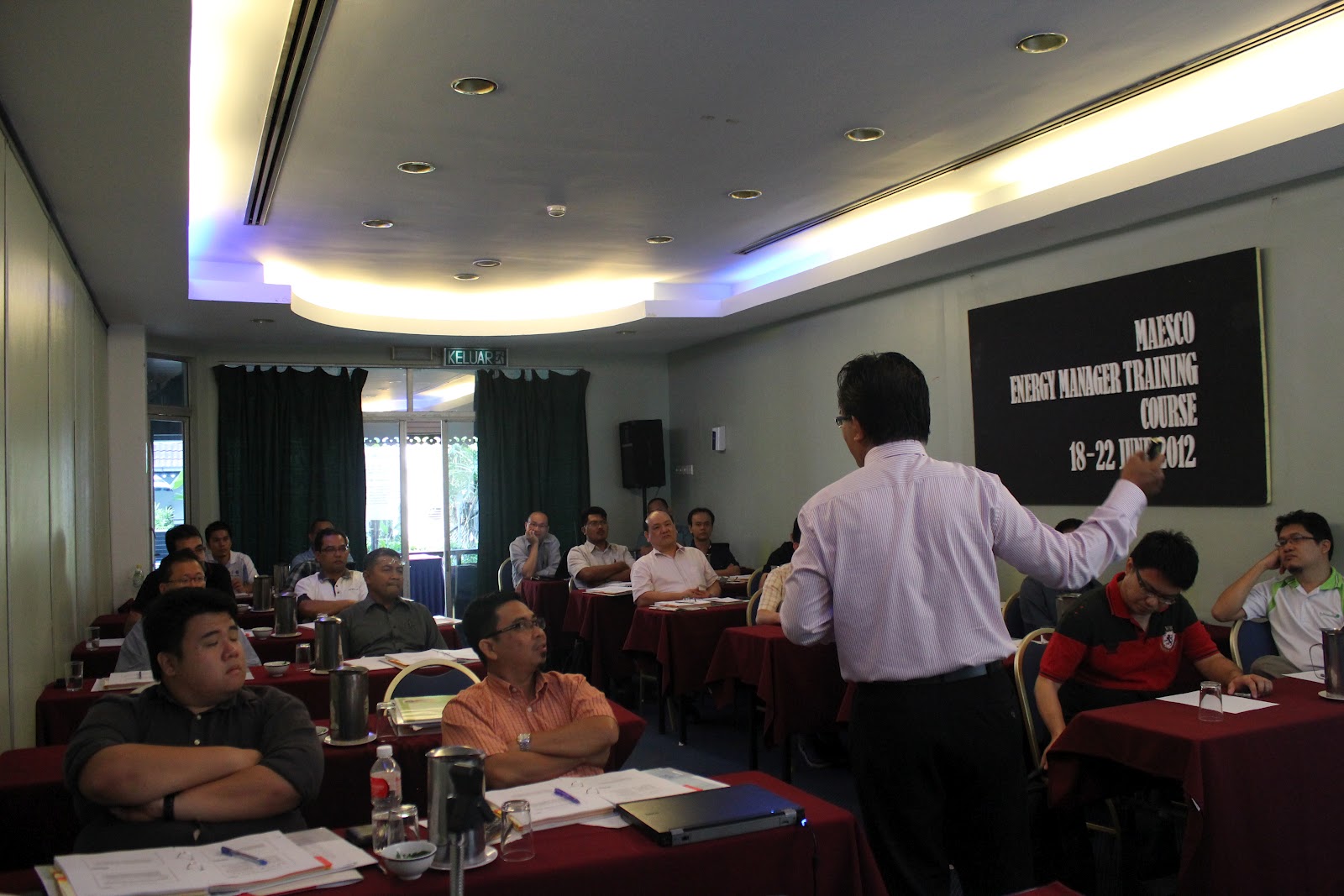
At the Energy Manager's Training Course on 19 June 2012
1. I have been a regular expert speaker in a series of events related to capacity building in energy management by MAESCO since 2009. The recent one is the Energy Manager's Training Course which was conducted at Shah Village Hotel, Petaling Jaya from 18-22 June 2012.
The participants were from various sector such as manufacturing, building, consultancy and also others who have some interest to embark on energy efficiency services. The next sessions will be in  September and December and details can be accessed at www.maesco.org.my

2. My session was on the second day and topics covered were energy resources & cost, energy management system and standards in energy management. Other topics covered by other speakers mainly on energy conservation measures, energy efficient technologies, energy audit, EE financing, energy monitoring & verification and etc.
3. For my topics , I have developed the presentation materials based on knowledge and experiences I gained from my participation in the industry over the years, from trainings organized by various EE related organizations such as Energy Conservation Centre of Japan(ECCJ), Institute of Energy Economic of Japan(IEEJ), The Energy Resources InstituteTERI) of India  and  United Nations Environmental Program(UNEP). 

4. On top of that, I also integrate the contents from input and information shared by other EE experts when I attended seminars, meetings, dialogues,forums and etc at local and international stages.
I must admit that attending various EE related trainings and exposure to EE at international level have been one of the best ways to learn and I gained so much in terms of knowledge and experiences too.

Why I chose Energy Management related topics?

5. There are many areas in EE that I have been involved in my career so far. As a practitioner I am competent to conduct energy audit for almost all type of facilities such as buildings and factories. For energy conservation measures, I have implemented measures my clients, managed the works and also measured the savings achieved from each measure for reporting and billing purposes.

6. When I was in the government, I involved very much on three areas namely regulatory works for EE covering designated big energy users and electrical appliances, awareness programs and finally the EE policy development and strategic implementation plan for the national level.

7.Across  all that, I have been  recognized as one of the regular speakers for various EE events and in these events, I was exposed to more people mostly  from the  management level  and decision makers too.

8. After performing some personal analysis on which area that I need to specialize in EE, finally I decided to choose energy management as an area that I wanted to become an expert  at national and international level. I personally concluded that , since I embarked into this EE field years ago, the technical or engineering solutions has been  the common concerns of many if they want to become more energy efficient but I believe  in the same time the management solutions is equally important to enable them to implement technical or engineering measures to save energy. I have seen so many viable and attractive EE projects that could not  be implemented due to the failure of the management groups or decision makers in in the organization to be convinced.

9. So, I prefer to complement the roles that have been played by others  to promote  EE technologies and practices to save their energy costs with some initiatives to tackle the management groups and decision makers where these people mostly have less interest on technical details of energy conservation methodologies.

10. The management people normally  look after the strategic components related  to financial  performance of the company and their core businesses.

Written test for participants at the end of the day
11. Energy management is the topic that may pull the management groups to listen to.Educating the on how critical of roles that can be played with little time that have to spend on it will be crucial to get their buy-in to enable the organization to embark on EE in a sustainable manner.

12. Those are among the main reasons on why I am now specializing in energy management in promoting and developing EE industry in Malaysia. As an industrial player, I am now able to provide both the technical  and management solutions to  the  market with technical part to be delivered by my engineering team and the lead for the delivery of the management solutions is me myself.

13. Personally, knowledge sharing is something that I really like to do and by involving in capacity building program such as trainings is one to the most effective channels  for it.

14. With the launching of ISO50001:2011 - Energy Management System Standard on June 2011, I strongly believe that everyone has the proper tool  to sell to the management groups on the needs to embark to EE in a holistic way. Then they would enjoy the obvious benefits later especially for those with energy costs have significant impacts to their operations and profits!

Monday, June 25, 2012

Energy Management Awareness Program with MDEC

This program was implemented upon a request from Multimedia Development Corporation(MDeC) and implemented together with Malaysia Associaotion of Energy Service Company(MAESCO) on 22 May 2012 at Cyberview Lodge &Resort, Cyberjaya.

The opening remarks by MDEC

The target groups was the middle-top management of cyber cities & cyber centres under MDEC.

The program started with opening remarks from MDEC by En. Saiful Izwan Mohd Shazali, Head of Business Environment and  Ar. Zulkifli bin Zahari, President of MAESCO.

The overview of program by MAESCO President


  Topics covered and presented were:
1.An  overview of energy scenario and energy conservation potentials  for buildings in Malaysia
2. Sustainable Energy Management System for organizations and  the strategic implementation steps
3. Case studies by MAESCO members for energy conservation projects
4. Financing mechanisms and options  to implement energy saving projects


Expert speakers involved were :


1. Zaini Abdul Wahab from Vesta Enertech Sdn Bhd
2. Dharamarajah from E-Eye Sdn Bhd
3. Iskandar Majidi from Climate Plus Sdn Bhd
and all of them also committee members of MAESCO
Zaini Abdul Wahab
Iskandar Majidi
Dharamarajah


Generally, all sessions were very interactive with some direct queries to each speaker and it was the first time an event addressing the energy efficiency matters of their facilities organized by MDEC.


Wednesday, June 20, 2012

MAINSTREAMING EE AS AN INDUSTRY...PART 3...COMPETENT & CENTRALIZED EE BODY

v) The need to have one- stop centre for EE in Malaysia 

Why do we need another body? Don't you think we have sufficient existing agencies to look after EE for the country? Would there be overlapping works if we create a new one and how to streamline everything at one body when energy itself is governed by few ministries and agencies in term of policies and implementation. The structure that I have shown in my post explained that concerns too.

For many years, even since I came into this EE field...EE efforts have been implemented by many parties and we can proudly say that..we have done a lot.I can list hundreds of EE initiatives that I came across  until today but can anyone answer this question...how much energy exactly that we have saved from millions of RM that spent on those initiatives? Who is accountable to monitor the whole progress and current performance and if anyone claimed they have achieved some amount of energy savings...who can verify and declare that as apart of our nation's performance? My involvement in the National EE Master plan study from 2008 until the time I left the government  has clearly concluded the same thing as one of the findings...MALAYSIA NEEDS A CENTRALIZED BODY FOR EE...whether it is new or putting it at any existing body...it is secondary to me. 

As the structure that I shared in the part 1 under the main title, there are 5 major components which require attention from the centralized body namely buildings,industrial,competency&accreditation, education&awareness and R&D in EE. Another three key areas to be taken care by the body; managing the EE fund,EE data and final the enforcement of the EE law. 

The existing agencies or organizations such as Energy Commission, Malaysia Green Tech. Corporation(MGTC and formerly PTM) and recently SEDA Malaysia  have  implemented some EE measures so far under various programs and project but can any of them take care all the above?

If any of them or someone with the authority to make that happen, I have 200% support for it. If no one is ready or still having reservations or still unsure...Malaysia has no time to wait any longer.The longer we wait, we will waste more and our nation's pocket will get lighter just to meet the need to subsidize more for every single unit of energy that we use and waste too! 

At BCA Academy, Singapore 2009

Having a dedicated body for EE is already a proven model in many countries and the idea to have in Malaysia is definitely not due to we just for the sake of following others.The closet example is Japan where hundreds of Malaysian have been trained in EE for years and from all the levels of people from policy makers to technical personnel. Why we still hoping to get different positive results when we keep doing it on piece meal basis by everyone for the past 20 years until this moment...we do not even know how much we have achieved. 

Policy makers may not feel the hassle and difficulties when there is no one stop center for EE in this country directly.It affects the users and industrial players!Even energy regulators may not feel it because EE does not affect the bottom line or competiveness for any of them although facts on our energy needs, performance and current&future supply status are with them.

Why? May be they are too busy focusing on the supply matters and all economic part of supply side.Nothing wrong with that but now we need to balance it with the attentions that need to be given to the demand side.

Having a new agency or body may not be a good idea too since they will involve extra costs when some existing agencies have already the foundation to carry on further. For example , Energy Commission has already some regulatory powers  in the existing Energy Commission Act 2001, Electricity Supply Act 1990 and the Efficient Management of Electrical Energy Regulations 2008 (EMEER 2008) as described in the following sections:

ESA 1990
Section 4: Functions And Duties
(la) to promote the efficient use of electricity

Part VA Efficient Use Of Electricity

Section 23a. Minister To Determine Standards, Etc.
The Minister may, from time to time, prescribe the standards, specifications, practices and measures to be adopted and any other matters in respect of the efficient use of electricity.

Section 23b. Installation To Meet Requirements.
No person shall use or operate any installation unless the installation meets such requirements as may be prescribed in respect of the efficient use of electricity.

Section 23c. Equipment To Meet Requirements.
No person shall manufacture, import, sell or offer for sale or lease any equipment unless the equipment meets such requirements as may be prescribed in respect of the efficient use of electricity.

ENERGY COMMISSION ACT 2001
Section 4
(g) to promote efficiency, economy and safety in the generation, production, transmission, distribution supply and use of electricity and the use of gas through pipelines and the use of gas supplied through pipelines
(i) to promote the use of renewable energy and the conservation of no-renewable energy
(j) to promote into, and the development and the use of new technologies related to-
   (i) the generation, production, transmission, distribution supply   and     use of electricity; and 
  (ii) the use of gas through pipelines and the use of gas supplied through pipelines

Based on my knowledge, those statements in the main act can serve as enablers  to come up with specific requirements for implementation that can be detailed in the form Regulations under the act. However, over the years, what have been done generally were on the promotional and awareness parts only on voluntary basis while the detailed regulatory  portion of EE  haven't progress that much.

The EMEER 2008 was introduced in 2008 and now implemented but it wasdrafted way back from 1997( the year I graduated from university).The first draft was more comprehensive and covered energy management, MEPS and also EE labeling but the final version only covers the management and very general too.
EC Building in Putrajaya

 My point here, if EC would like become the centralized body for EE, there should be a very significant and drastic changes to the current EE set up to deliver what is required for the country to look after all components in EE industry.

The current has been clearly unable address the changing needs of EE industry in the country and for years, EE has never treated  as one of their "core businesses" especially when it became a unit from a department since 2008.

I was involved partly in the set up of PTM in 1999 and prepared the capacity building program for the initial batch of the staff too. The idea of setting up PTM was to cater the needs of having one agency for EE too which would serve as a think-tank for strategic EE matters,coordination for implementation, R&D and many more. Now, I am not sure what really happened against what the initial intentions of it establishment since they are officially known for green related matters which have broader scopes.
MGTC Building in Bangi
There are some suggestions to park EE under SEDA Malaysia which is currently responsible for RE Act and FiT for RE  development in Malaysia but still no clear decisions on that matter too.
SEDA Malaysia at Galeria PjH Putrajaya
The execution of the specified functions in the centralized body for EE need to be planned, strengthened and supported with   the utilization of existing institutions or organizations based on their already available facilities and in-house expertise.

The centralized EE body  will tie up with these institutions or organizations and work together strategically in long term basis with agreed terms and conditions.
Below are some of the proposed scope of  duties  for the EE Centralized EE Body that I can share with all the readers here based on what I believe and  from some readings and references in few countries that have been succesfully implementing EE initiatives.

General Scopes
  • To advise and assist the government to develop EE policy, law and regulations;
  •  As a one stop agency to coordinate, monitor and to ensure measurement and evaluation to be carried out to determine the impacts from the implementation of EE activities;
  • To prepare, implement and to monitor all planned activities for EE
  • To perform the regulatory works such as enforcement, investigation and prosecution for no compliance of EE law, regulation and standards; and
  • To coordinate and monitor all collaboration activities to be carried out with agencies and organizations for local and international levels.

Scope of works need to be defined for based on the core elements in the implementation of EE&EC activities and the details is  described in the followings

At TERI Gual Pahari, Gurgaon,India, 2008

Compliance and Technical Support for Designated Buildings and Industrial Facilities

Training with ECCJ Expert in Kita-senju, Tokyo Japan,2008
  • To perform evaluation and technical assessment for the compliance with   EE law and regulations based of on reports submitted by selected high energy   users on their EE program;
  • Monitoring and verification of compliance for high energy users based on reports submitted;
  • To provide assistance in technical supports in energy auditing and the implementation of EE  projects;
  • To assist in the publication of guidelines on energy audit, EE project implementation and management, best practices, energy management system and etc;
  • To assist in the development of standards for energy efficient equipment and appliances;
  • To carry out analysis or technical evaluation for projects that have been implemented or on-going upon requests or required;
  • To perform technical measurement and project monitoring works for EE projects;
  • To provide expertise and experts   for training program delivery as speakers or facilitators; and
  • To coordinate and monitor activities carried out by organizations appointed to perform some of its functions

Competency and Accreditation
  • To establish certification and accreditation procedures for energy managers, energy auditor and energy services companies (ESCOs);
  • To establish accreditation procedures covering selection, evaluation and monitoring for institutes/training centers to carry out trainings for competency;
  • To prepare syllabus and materials for trainings;
  •  To identify trainers to conduct trainings;
  • To prepare examination questions and conduct national level examination for competencies;
  • To manage registration and renewal of registration for competent persons and ESCOs;and
  • Assist in providing materials or input to increase awareness on the requirements and the importance of competency and accreditation to implement EE activities.
With Key Officers on EE from Asean, Singapore 2011

Equipment and Appliances
  • To carry out research on   Minimum Energy Performance Standard (MEPS) for selected equipment and appliances;
  • To enhance, improve and continue the labeling program and promotion for refrigerators and high efficiency motors;
  •  To have an established partnership program with relevant organizations to carry out the research on standard,   labeling and to provide testing facilities;
  •  To develop and decide on standards to be used in energy efficient appliances;
  • To establish procedures for approval and certification of energy efficient equipment and to implement the standard and labeling program;
  • Assisting in on-going promotion of the energy efficient standards and labeling program to manufacturers, importers and general public about types of label introduced;
  •  To coordinate and monitor activities carried out by organizations appointed to perform some of its functions such as SIRIM for testings.

Education and Awareness
  •  To coordinate the implementation and monitoring of educational,   campaign and promotional activities for industries and public carried out by the body and other organizations;
  •  To carry out evaluation on each program on all activities implemented in order to measure their performance;
  • To ensure dissemination of information  with regard to the requirements for competencies, standard and labeling for energy efficient equipment, the importance of efficient energy management  and energy auditing, best practices in energy usage, new technologies and many more;
  •  To establish cooperation with relevant educational agencies such as Curriculum Development Center in order to enhance the contents with regard to EE in school syllabus;
  • To propose to the Ministry of Higher Learning to introduce EE courses at universities in order to produce professionals and experts in EE  field;
  •  To introduce recognition and reward programs for individual and organization on their significant contributions or the implementation of project with regard to EE;
  •  To publish and distribute brochures, guidelines and etc with regard to EE to all sectors of energy users; and
  • To coordinate and monitor activities carried out by organizations appointed to perform some of its functions such as CETREEE.


 R&D and Technology Applications.
  •  To identify areas in EE and carry out R&D activities;
  • To establish cooperation or strategic partnership programs with various agencies at local and international levels with regard to research and new technology applications in EE;
  • To develop and assist in the publication   of guidelines on EE;
  •  To identify and showcase demonstration projects on EE and its accomplishment;
  • To develop, introduce and maintain centralized database systems for energy sectors;
  • To assist in the development of standards and introduction of new technology in energy efficient equipment; and
  • To coordinate and monitor activities carried out by organizations appointed to perform some of its functions such as  universities and research institutes.
At Solar Research Centre, Gual Pahari , India

Other scopes would cover the management&distribution of the EE funds, enforcement of the EE Law and accountable for EE related data for the country.


I we go to Japan, whoever performing EE initiatives, finally they would have to come across Energy Conservation Centre of Japan(ECCJ) for any EE technical reference, assistance, trainings and etc.For energy related data in Japan, they have the Institute of Energy Economic of Japan.

If we go to India, there will be Bureau of Energy Efficiency as a regulator and technical related matters can be referred to bodies like The Energy & Resources  Institute(TERI). Then, if we go to Singapore, for building EE matters can be referred to BCA for and in Thailand they have the Department of Alternative Energy Development&Efficiency(DEDE) and the details about them can be referred at websites as below:

http://www.asiaeec-col.eccj.or.jp/index.html

http://eneken.ieej.or.jp/en


The structures, responsibilities and accountability for EE in these countries are clear and made known to everyone. People and industrial players know where to refer but sadly in our country, the moment you want pursue EE related matters you may need to go partly to endless list and finally you may end with nothing too despite time have been spent for your searches.

The immediate example is, if you want to apply for EE&RE  Fiscal Incentives, you have to go to MIDA  and later to be forwarded to EC for EE and  last MBIPV Project Team for RE products. At each stop, no one can assure you  the actual time frame when you will get the decision for your applications.However, they may have improved now...I don't know.

Until today, still no decision made on who is suppose to be responsible and accountable on EE and the more we delay it, it will definitely putting uncertainty in the industry itself because we have to listen to many with different ideas and opinions on what's the best.

Finally, my point here again, we need the centralized and competent  body for the implementation of EE matters or a dedicated body to look after each component or some components in EE industry in Malaysia and that has been a proven working model in many countries.