Wednesday, January 9, 2013

EE Governance...key findings on EE policies by International Energy Agency

Here I would like to share some information and my personal views  on the development of EE governance in Malaysia based on the presentation by Mr. Robert Tromop, Head of Energy Efficiency Unit in the International Energy Agency at IGEM 2012, KLCC. 

I believe he has the right credentials to speak about the given topic since he informed us that he personally invited by the Secretary General of the ministry to have have that special session at IGEM 2012 to talk about EE policies and governance for countries. 

Among the participants in the workshop by Mr. Tromop were the Secretary General of the ministry and other officers from related organizations  such as Energy Commission, SEDA  Malaysia, TNB, SIRIM, MAESCO, some universities and etc.

I was a very interesting session when Mr. Tromop shared findings from studies by IEA for may years and at many countries on EE policies and gave his views openly and independently especially when he answered questions and responded to remarks from the audience. 

With Robert Tromop, Head of  EE Unit, IEA at  IGEM 2012 KLCC
Here I extracted some of his presentation slides which I believe were key areas that need to be given due attention for a successful and sustainable implementation of EE initiatives in Malaysia. 

Most of the slides presented by Mr. Tromop were self explanatory especially for those who have been involved in energy efficiency at various levels and programs. He was again reiterated some key points that many local and international experts pointed out to the government on the governing of EE but yet to receive the much desired responses and productive actions.


EE Governance
The above figure clearly shows what are the key elements to govern EE in any country comprehensively.Are all that so new most of us who were in that workshop ? My answer is NO since what was summarized by Mr. Tromop is not something that has been shared by many other EE experts    for many years in many similar events. On top of that, findings from the National EE Master Plan(NEEMP) Study by local and international EE experts carried out in 2009-2010 indicated almost the same conclusions.

I did ask Mr. Tromop on the top 3 components namely Enabling Frameworks, Institutional Arrangements and Coordination Mechanisms, do we need all of them  and his answer was YES, all of them must be there all the time at the same time to have a really good start. It would be similar to the sub components under the main components as well since they are required to ensure EE implementation could be sustained and leading towards achieving the intended targets for the nation. 

EE Law

Some may argue that why do we need another law for EE. Do we enough  existing law that can be utilized to get what we really want to see in EE development? Yes  we have some laws but the issue here is, is there anyone looking into it and trying hard enough to utilize it or to make it usable for regulate EE implementation? Who is suppose to do that and for the past 20 years, what have achieved with the current law and organizational regulatory setup on energy?

A dedicated EE law has been proven as one of the key policy instruments for a successful and sustainable implementation of EE in many countries. Are we trying to be naive or we are just to arrogant to follow good things that have been proven worked in many economies in the world on how to approach EE for their respective country.

I strongly believe the recent move by the ministry to stop drafting the EE Act was another step that will bring us backward. To make it worst that move was taken without at other plan on how to make a big leap for EE development as an alternative other than as recommended in the Draft NEEMP. To prove that, basically there has been almost ZERO new  development  on the strategic policy and actions on EE for Malaysia in the whole 2012 when most of the time was used by some people in the  policy making side to bicker among themselves about their personal agendas.

Sadly to say that, we saw only much promises and individuals to disrupt the good development in EE  rather than productive actions which are urgently needed strategically that will improve our approach towards EE.


I was involved at various stages of the development of the Draft NEEMP for Malaysia.It started from the early idea to have the NEEMP study in 2008, then the development of the Term of Reference for the study, the study by the consultants appointed and finally reviewing the report submitted  as a member in the technical evaluation committee at the ministry from 2009 until 2010 when I was the   Head of Demand Side Management in Energy Commission.

The progress of the Draft NEEMP has been quite unique to me since it was developed after going through different level of reviews and by different group of people involved in EE in Malaysia and some foreign experts.


Firstly, the consultant appointed by the Ministry in the form of a consortium comprising established EE experts from Malaysia  and  among the leading energy economists and EE technical experts from Japan.


Secondly , another established EE expert from Denmark was appointed for the purpose of having an independent review of the findings and recommendations in the report and to look at key areas and numbers that could be be worth  it to be reviewed to come up with improved plan.


Then finally, in the end of 2010, the reviewed plan was reviewed again by another group of EE experts from APEC under the APEC Peer Review for Energy Efficiency for participated member countries. Details of the findings and recommendations can be accessed at http://www.ieej.or.jp/aperc/PREE/PREE_Malaysia.pdf.


That review by APEC was carried out by another group of EE experts especially from Japan, USA and Singapore.


Energy Commission is now the lead agency for EE in Malaysia as decided and announced by the ministry in one of the EE seminars recently and but until today no one has any idea what does that meant. My understanding is EC is continue what they have been doing for many years with no clear goals and targets at certain time frame.  So, we are now back where we  were before despite there are some practical and achievable  EE initiatives recommended in the draft NEEMP document which do not require additional fund  or new  law  for EE to be introduced. However, to be fair, everyone now will have to wait for EC to prepare and later announce their plan as a lead agency for EE in the country

Several options have been recommended in the draft plan and reviewed few times based on feedback from various parties in order to make it more realistic but at present I cannot see anyone is seriously looking into it. Many  proven mechanisms and practices could be considered to ease the funding burden from the government but require collective efforts and understanding to ensure the  NEEMP implementation will be sustainable but what we need now is the champion at the policy making side to convince the government.
Various engagements have been carried out in the development of Draft NEEMP for Malaysia with key stakeholders in EE but the draft has been asked to be reviewed again due to personal opinions.
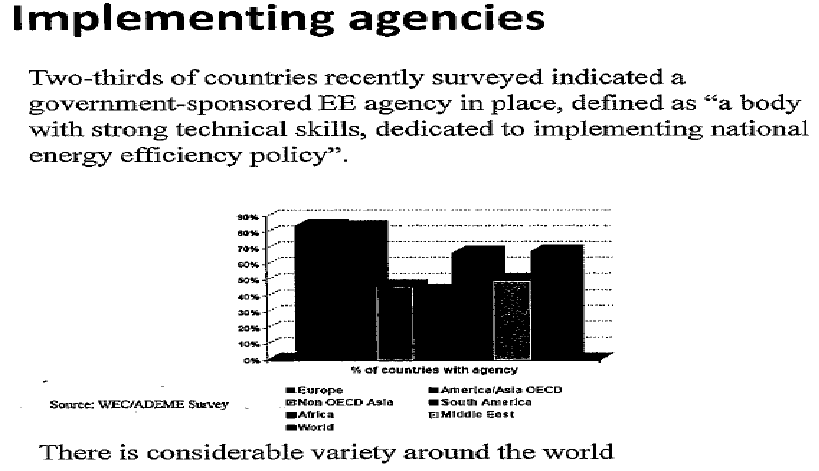
Example of countries that have introduced their strategic plans for EE implementation. What is taking Malaysia so long until today?

The final version of the NEEMP is still a confidential document but some of the key findings and recommendations have been presented by the ministry at several  sessions with key stakeholders such as related government ministries and agencies, industry & professional associations, NGOs, consumer groups and etc in 2011.

From what have been shared, key findings and recommendations for NEEMP were not  much different from what have been faced and happened in many other countries when they started to embark on long-term EE initiatives in more sustainable manner.


Something that may be  different compare to them for Malaysia is about the nature of of energy prices which is heavily subsidized and level of authorities on energy that placed at different government entities.


What I could recall from those  presentations  about some of the key barriers for EE in Malaysia are as follows:

  • Lack of overall national level plan for energy efficiency that can be referred by all energy using sectors
  • Lack of consistency in embarking on the energy efficiency
  • Lack of legal and regulatory framework for energy efficiency
  • Lack of champion to drive the introduction of strategic energy efficiency  plan
  • Low energy prices due to government subsidies
  • Lack of sustainable funding sources and financing mechanisms for energy efficiency projects and programs
The above findings is shared by all the three EE expert groups that involved in the development and reviewing the Draft NEEMP.


The failure to have common targets and goals for EE at the national level will lead towards uncoordinated individual  and organizational efforts which may end up in many parties doing the same thing at smaller scales with less or insignificant  impacts to be seen and measured to convince the majority to take part.


Key points on the importance evaluation of impacts from EE programs

Key recommendations in the draft NEEMP are basically as counter measures to overcome the identified barriers and those measures were again, confirmed and very well outlined by Mr. Tromop in his presentation based on findings by IEA on how to govern EE in a country. The draft NEEMP  document is actually a comprehensive outline of the governance of EE in Malaysia. I could not say that is a perfect document but should be comprehensive enough as guide for the country to make  significant change forward in EE. 

There have been some questions and arguments of some of the key numbers especially on the key indicators such as energy saving targets in energy consumption, generation capacity and etc but these number can be reviewed and discussed to come up with numbers that all stakeholders will be comfortable with.

My conclusion is  Malaysia would not be able to get different or better  results from EE initiatives with the way EE has been governing now and this has been a practice for many many years with no clear policy. EE efforts have been implemented mainly on project basis with no clear steps to be taken upon the completion of each project. 

I remember being asked some EE related questions at some public event at international level as a government officer where I would be happy to answer on how many EE projects implemented in Malaysia over the years because we have implemented many indeed. My trouble always when trying answer any EE question on how much Malaysia has achieved from all EE projects that already implemented because I do not  have the answer and I do not think anyone in Malaysia would any definite answer too. Why? It is  simply because no one is accountable for evaluating the impacts of all those EE initiatives and we can get all sorts of numbers from many sources which no one could verify and stand with it.

We need to have the EE Policy and then to be followed by the creation of a Legal and Regulatory Framework for EE implementation with clearly defined national goals and target. This EE policy will serve as a common goal for everyone on what we would like to achieve for our EE efforts in the country.

To do that we also need to have a Centralized Agency for Energy Efficiency which will be fully accountable for EE implementation with required competencies to lead EE industry with their assistance and on -going support measures to all energy using sectors. 

We need to have a well developed Funding and Financial Mechanisms which we have a plenty of options that can be explored, considered and then introduced. 

While having all the above, we need to continue to carry out  capacity building and training programs to produce more EE professionals to support EE  implementation  through on-going  education and awareness programs.

I strongly believe the above 4 areas are key thrusts of implementing EE initiatives for Malaysia as already proven in many countries and again highlighted in the presentation by Mr. Robert Tromop from IEA.


Friday, December 28, 2012

PREPARATORY WORKSHOP FOR ELECTRICAL ENERGY MANAGER’S APPLICATION UNDER THE EFFICIENT MANAGEMENT OF ELECTRICAL ENERGY REGULATIONS 2008


A night before the first session...and now we are into the fifth session

Workshop Sessions  for 2013

Dates:                                       
  • 3rd Session: 23 February 2013 (successfully conducted)
  • 4th Session:27 April 2013(successfully conducted)
  • 5th Session:13 July 2013 (registration is now open...)

Venue:
Shah's Village Hotel,  Petaling Jaya

Fee:
RM600/participant
RM500/partcipant( for a company with at least 2 participants  in the same session)

Contact details to register


MAESCO
Tel:
+603-78730784
+603-78730786

Fax:
+603-78730769
E-mail: training@maesco.org.my      or
log on to www.maesco.org.my for the registration form.


INTRODUCTION

I started this program in the end of 2012 with the ultimate goal to assist the regulator to increase the number of REEMs in the current market which is still insufficient to ensure compliance towards the Efficient Management of Electrical Energy Regulations 2008. It was announced by the regulator recently that as at December 2012, only 207 REEMs registered with them and there are about 1,500 installations have to comply to the regulations. 

Together with MAESCO, we had two sessions in September and October 2012. Now  I intend  to expand this program to be conducted at more platforms to enable it to reach more people who may be benefit from it.

Actually,I believe there are many people out there with experiences and qualified to apply but still unsure on how much they have met the requirements and how exactly to put all that in writing in the application form. Some even have the idea of  it would be easy to get registered, the interview and examination would be very tough to pass and many other perceptions that make them not applying.

It the workshop, me myself with assistance from 1-2 more REEM will share our experiences from the beginning of the application process until the interview session  by the panelist.I will also will share my direct experiences in evaluating the applications and as one of the panelists for the interview session. The whole idea of the outline program as indicated below is to guide the candidates in the application process and to build their confidence to submit if they have met the minimum requirements according to the regulations. 


TARGET GROUPS:
  • Companies affected by the enforcement of Efficient Management of Electrical Energy Regulations 2008 - for those interested to get their internal personnel to get registered
  • Training providers who are interested to  add new program into their training calenders
  • Individuals and consultants who are interested to offer REEM services to existing and new clients

LEARNING OUTCOMES
                  
By the end of the workshop the participants would be able to:
      prepare a completed application form to become A Registered Electrical Energy Manager
      prepare for an interview by Energy Commission
with the comprehensive step-by-step guidelines and tips by the workshop leader

9.00 a.m
Introduction
9.15 a.m
1. Overview on key provisions in  Efficient Management Of Electrical Energy Regulations 2008
10.15 a.m
Morning Break
10.30 a.m
2. Evaluation criteria for application to register as electrical energy manager  under Efficient Management Of Electrical Energy Regulations 2008
  • Scoring system
  • Experiences in efficient management of energy
  • Submission of report on energy saving projects
12.00
3. Workshop
  • Tips to complete application form
  • Tips to prepare energy saving report
1.00 p.m
Lunch

2.00 p.m
4. Tips to prepare for the interview
3.00 p.m
Tea Break
3.15 p.m
5.Workshop
  • Practical  exercise/simulation( facilitated by 2 other experienced REEMs)
  • Remarks and lessons to learn
Wrap up session and Conclusion

5.00 p.m
End of  program

GENERAL INFORMATION

  • Trainers are certified by PMSB and qualified companies eligible to claim from HRDF
  • Materials requirements
    •  Sample of  report(s) For Energy Saving Project by each participant(to be used for the workshop)
    •  A copy empty application form for REEM  registration by each participant –  can be downloaded from www.st.gov.my (to be used for the workshop)
  • No guarantee to get registered with Energy Commission since the result of the application  will depend on the actual performance of the candidate in the interview session by the Energy Commission 
  • Available for in-house and public programs

OPTIONS FOR THE PROGRAM

In-house:
  •  5-10 participants
  • Venue, LCD Projector,  Food and Beverages – to be provided by the hosting company
  • Workshop notes  from the trainer
 Public:
  • 10-20 participants
  • Venue, LCD Projector, Food and Beverages – to be provided by the organizer
  • Workshop notes  from the trainer
The number of participants for each session is limited to ensure more interaction and facilitation by the the workshop leader and other facilitators.

Further inquiries can be forwarded to zainiabdulwahab@yahoo.com  or  to contact me at 0192152700


BRIEF INFORMATION OF  THE  WORKSHOP LEADER


ZAINI ABDUL WAHAB

Mr. Zaini Abdul Wahab started his career as energy efficiency (EE) consultants  in 1997  for  local and multinational consulting firms and assigned to secure and deliver services to industrial and commercial clients.

He joined Energy Commission of Malaysia in 2004 and then promoted to head the Demand Side Management (DSM)to regulate, develop and promote EE  industry in Malaysia from the head office in 2007. Among his key responsibilities in Energy Commission was preparing the strategic implementation and enforcement plan for the Efficient Management of Electrical Energy Regulations 2008, technical evaluation for EE and RE projects for fiscal incentives under MIDA, EE capacity building programs for industrial and building sectors and standard and labeling for electrical appliances.

He  was deeply involved in the preparation of  the  evaluation criteria for application to become a registered electrical energy manager(REEM) and was one of the panelists for the interview sessions for qualified applicants from 2009 until 2010 when he was the head of the DSM Unit in Energy Commission.

Then Mr. Zaini was  appointed by the Ministry of Energy, Green Technology and Water(KeTTHA) as one of the key experts to prepare and propose strategic energy efficiency  initiatives in the National Key Economic Area (NKEA)  Lab by PEMANDU under Oil, Gas and Energy Sector(OGE)  for Economic Transformation Program (ETP) in Jun-July 2010. Then he was assigned  to Head the special Project Unit to implement energy efficiency initiatives under the Entry Point Project 9(EPP9), OGE, ETP at KeTTHA  from  January until  August 2011. In the same time he was extensively involved in the strategic national policy and legislation development for EE  and conservation with the ministry as the key technical resource person.

Mr. Zaini became the Director of Energy Efficiency at Sustainable Energy Development Authority (SEDA) Malaysia to continue leading national  EE  initiatives under  ETP and also as the key resource person in the drafting of  the proposed EE & Conservation Act by KeTTHA.

Now Mr. Zaini is the Director of Operation at Connecsys Sdn Bhd, a company specializing in investments, consultancy and advisory for total energy conservation and renewable energy projects solutions & implementation.

He is a registered consultant with Asia Development Bank and an elected committee member in the Malaysia Association of Energy Service Company(MAESCO). In capacity building programs, Mr. Zaini is  an expert  trainer  for MAESCO’s energy management training courses  and  in Industrial Energy Efficiency for Malaysian Manufacturing Sector Program  organized  by  United Nation Industrial Development Organization(UNIDO)  from 2012.

KEY AREAS OF EXPERTISE AND EXPERIENCES
  •  Sustainable Energy Management System development and ISO 50001: Energy Management System(EnMS) requirements for organizations;
  • Energy efficiency and conservation regulatory framework and policy development for countries  and organizations;
  • Planning, development and conducting capacity building programs in energy management & energy efficiency applications and technologies.
  • Energy auditing, measurement, monitoring of energy performance and utility cost analysis for industrial and commercial buildings; and
  • Technical evaluation  of energy conservation projects;


Qualifications:
  •  Registered Electrical Energy Manager with Energy Commission (PTE-0016/2012)
  • Certified Trainer by Human Resource Development Fund(HRDF)
  • Bachelor Degree in Mechanical Engineering(Hons),UKM.
PREVIOUS WORKSHOPS


Fourth Batch on 27 April 2013


Third Batch on 23 February 2013


Simulation of interview session with experienced REEMs as panelists


Lecture

Tips for report writing for submission


Practical: Interview session by REEMs


First batch


Workshop


Practical: Answering interview questions

second batch


Wednesday, December 26, 2012

How much energy cost can we save for government buildings?


I did some information gathering from presentations slides by the regulator and ministry which were shared through public events and I managed to summarize my findings and estimation of potential energy cost savings as the shown in the table above.

From 128 buildings, the total electricity bills is approximately RM630 millions per year and the total is about RM2.7 billions per year. With a very conservative target at about 10% savings per year, the government would be able to save electricity cost at RM63 millions and RM270 millions respectively. Based on many case studies, the 10% could be achieved through low-no cost measures and by the implementation of energy management system the organization.

Refrofitting projects to save energy costs for existing buildings by the government could be very costly and this is where the private sector could take part by investing and get paid  from the actual cost savings achieved through Energy Performance Contracting(EPC) model.

From the above numbers, we also would understand why some parties questioned the potential savings from LED lighting at government buildings at RM800 millions per year as announced by the YB Minister at one of his press conferences recently. It look like the whole lamps has to be switched off to get that amount of expected savings and based on this gathered data and estimated potentials, we can say that it is impossible. Surely , the minister is  unhappy since I believe  his statement was based on advice and information forwarded to him from his ministry.

Now , we go back to the main point here. There are potentials for energy savings in government's building facilities and the platform should be provided for  interested parties like ESCOs to play their roles.

Below are some key points, recommendations and proposed support measures to the government to enable EPC to work at government  buildings as I presented at the Seminar on Energy Efficiency Initiatives for Government Buildings , 19 December 2012, PWTC Kuala Lumpur.


Recommendations

q  To create a special revolving  fund for EPC Projects with lower interest rates – to kick-off and develop the EPC market
q  Development of in-house capacity in technical & financial evaluation of EE&EC Projects for
q  Authorized agency
q  financial institutions
q  Development and acceptance of standard technical evaluation, monitoring and performance verification criteria for EE&EC Projects
q  With by technical  experts from  recognized professional/industry bodies/ associations
q  Development of and acceptance of standard  evaluation for funding and risk assessment criteria for EE&EC Projects
q  Sharing  of experiences in successful investments in EPC projects through seminars/dialogues
       (results, payback period) from people in business community who have experienced it
       Criteria of viable EE projects
       Competency of ESCOs

The Conclusion


q  EPC
ü  The potentials in Malaysia is still relatively “UNTAPPED”
ü  Interested parties must have the same understanding & goals on how to make EPC works
ü  ESCOs must have/develop  competency & capability  to ensure successful EPC projects implementation
ü  More successful EPC projects are required to attract more attention of building owners & banks/investors


Presenting on EPC process


The audience: From biggest electricity users of government buildings


To summarize the impacts of EPC, I have outlined it at the end of my presentation in the slide below.


In short, EPC is not only about the tool to save energy costs or government's money(people's money), it could also contribute in the economic development in the way forward and protecting the environment for our future generations.