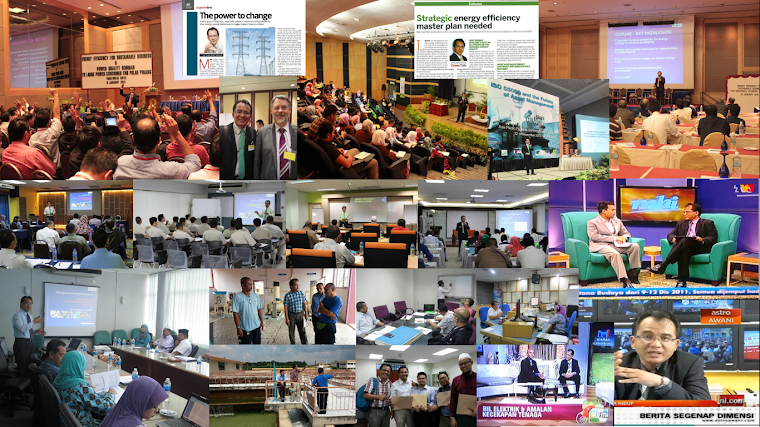
Saturday, December 8, 2012

Energy Performance Contracting(EPC) for Energy Conservation Project Implementation


EPC is making its way into government's buildings but met with some bureaucratic hurdles from within the government.


First EPC Workshop by KeTTHA on 31 May 2011 at Shang Ri La Hotel Putrajaya for Public Universities


Now, while the bureaucracy issues findings its way towards a solution, let us have some basic understanding what is this EPC all about and why it could become significant in exploiting the potentials of energy cost reduction in government building facilities.

What is Energy Performance Contracting?
In simple terms,
EPC is a project approach that utilizes the energy savings and revenue gains to pay for the project cost.             
- Land-of-Sky Regional Council, USA.


Who can perform EPC project?
EPC is performed by an entity generally known as Energy Service Company (ESCO) which  Develop and implement turnkey, comprehensive energy efficiency projects. ESCOs offer performance-based contracts (i.e., contracts that tie the compensation of the ESCO to the energy savings generated by the project) as a significant part of their business.
ESCOs must also demonstrate the ability to provide the full range of services required for a comprehensive energy efficiency project covering:
  • Energy Audit
  • Consultancy
  • Design of energy efficient systems
  • Implementation Project Financing
  • Implementation and Project Management
  •  Construction management
  • Energy performance monitoring and verification performance
  • Testing and commissioning
  • Operation and maintenance
The Second EPC Workshop by KeTTHA for Government Agencies on 22 June 2011 at KeTTHA Office

How to make EPC works?
To have a workable EPC implementation, the procurement process must suit the EPC business model and process flow and to have that the government officers and decision makers responsible to manage EPC must understand what is EPC and how it can work. EPC cannot be treated like a typical conventional procurement of products or services by the government. Some have tried using the typical tendering process but failed and one the reasons is... no ESCOs were interested due to impractical conditions and limitations. For example, a detailed energy audit it a costly exercise and no one would be willing to performed it with no certainty that they will be awarded the EPC contract.


Secondly, feasible EPC projects are only about installing new energy efficient equipment or installing energy saving devices and thirdly, the sharing from the achieved savings between the ESCO and the client must be from the actual and measured performance rather than from the calculated quantity when the proposal was made and agreed.

A full fledged EPC player in shared-savings model should have the capacity to perform the full scope works involved in the EPC itself.It is very crucial to gauge the commitment of the prospects from the beginning if they are really keen on EPC model to save energy costs at their facilities. Normally they are keen due the so called Zero Cost concept when actually the whole process is not really zero cost. Energy audit is a cost as well as the implementation and followed by the monitoring, measurement of energy performance to establish baselines and actual savings, operation and maintenance of affected energy using systems.

The beauty part of EPC from the building owners' point of view is there is actually Zero cost upfront especially in energy audit and investment for the implementation. They just need to pay back all the costs incurred in the whole process purely from the actual savings achieved from the energy saving measures implemented by ESCO.

In normal cases of EPC, it would take quite a long time to get everyone on the same page on EPC concept although all parties have indicated their interest from the start because in most cases too, the final decision is not with the technical personnel( as always).This lengthy  process and discussions to reach and agree with the contract's conditions with the ESCO and key decision makers at the client's side is to avoid future disputes especially when the payment to be made to the ESCO which will involve so many questions on the measurement and verification of savings.

In fact,  we also need to be very clear on the actual savings achieved's  definition. I came across facilities owners signed EPC contracts based on actual savings achieved but it is purely from theoretical calculations for certain period of time. In EPC, ESCOs should be paid or rewarded based on the actual performance and that actual performance must be based measured data from the agreed baselines which is also based on measured indicators at agreed operating conditions.

EPC is not just about a technical exercise which involves technical solutions and paying back from the savings achieved from it. To make it happen, one more important element is to gain the trust and confidence of the prospects that EPC will benefits them in more than just energy cost reduction.EPC could also be seen one way to let ESCO as the expert to perform the energy management tasks for the client and ESCO to play significant roles that will make them as a strategic partner rather than just as a service provider or product supplier.
With the average 5-7 years of typical EPC contract period, a lot to consider before it can be signed by both parties especially on the ESCO's side when so much risks at stake when investment made.

On top of that it is also crucial to determine the viability to invest under EPC. This is what happened few years ago when a government agency tried to implement EPC as a pilot project and later did not manage to attract any single ESCO to participate. Then they reviewed the contract period to make it more feasible but unfortunately the tendering process do not suit the EPC business model...still unclear what will happen next since they are still pursuing it until today.

To my knowledge and experiences, 3-5 years period is only suitable for certain measures at small or medium scale of investments...and it would not be a comprehensive solutions too if you we are talking about office buildings with typical operations in less than 12 hours daily.

Yes, the real challenge is how ESCO can recoup their investments and making profits at agreed period.This is actually the most tricky part of EPC and will lead to one big question..HOW CONFIDENT OF THE ESCO TO GUARANTEE THE PROJECTED SAVINGS FROM WHAT THEY PROPOSED TO THE CLIENT?...this type of question normally comes from the decision makers especially from financial controllers and also the possible financiers...the failure to convince them may end up with the big NO for them to proceed and even they agree to proceed...it will open to further disputes when actual performance to be verified...when invoice is sent to them to pay from the savings claimed by ESCO that has been achieved.
Most users prefer not have EPC financing to be in their balance sheet and in the same time, they need to be educated on long term benefits and risks on ESCOs when they invested through EPC shared saving mechanism.

To my knowledge, there are not many comprehensive contracts being implemented by ESCOs  in the current market even though  in the private sector. Most of them are focused on certain solutions such as HVAC and lighting for commercial buildings. There some EPC contracts involved technologies called as energy saving device where it is claimed to save energy when installed at certain points in the internal electricity distribution systems.

For government sector , more need to be done to educate different level of people in the administration and decision making.  Series of consultations, workshops, dialogues and discussions have been taken place for the past 2 years to promote EPC model which will also ease the financial burdens of the government in managing its utility costs and to source extra budgets to implement energy conservation measures.  At least MoF has accepted the idea and has been formalized through the creation of a new code for ESCO. Payment to ESCOs also is allowed to be made under EPC by utilizing existing payment codes for the expenditure and quite number of relevant people in JKR have started some initiatives  to move towards EPC for the purpose of implementing energy conservation project.  Now the focus must be more on the actual target groups which is the management or the owners of government buildings facilities itself.

The Malaysia Association of Energy Service Companuies(MAESCO) was invited by Energy Commission to  present a paper titled Energy  Performance Contracting at the Seminar on Energy Efficiency Initiatives for Government Buildings on 19th December 2012 at Putra World Trade Centre. The seminar is aimed to create awareness and generate interests form the targeted audience who are  representatives  biggest users of electricity users among government buildings on energy conservation opportunities and options to implement energy conservation projects such as through EPC model. This is a good move by the regulator and MAESCO, which I am going to represent as the  speaker at the seminar, will continue to support this efforts especially to educate the users on EPC and how EPC would lead to win-win scenarios for public and business community in private sectors.

Letter of invitation from Energy Commission to MAESCO to present on EPC topic

I am looking forward to presenting at the seminar and to gauge more feedback and comments on the way forward to promote EPC in the public sector since the EPC market in this sector has been almost untapped.

Effectiveness of REEM in Malaysia (Part 3):Types of REEM


1. To become a REEM under EMEER 2008, you do not have to a technical specialist or specialized in other areas in EE.Then, appointment of REEM by any company for the purpose of compliance only will not gurantee any energy cost reduction yet. However, being a specialist in certain areas especially on how to identify and implement energy cost saving measures definitely will bring more values to companies appointed them as REEM at their facilities.

2. Now I would like to elaborate further on what type of REEM that anyone possibly could be. To be realistic too, monetary factor would be one of the key factor among others. 

3. Another key factor is what is the market(installations affected by EMEER 2008) expects from REEMs which very much depending on how they see the implementation of the law as I indicated in the previous post.

4. I am not trying to which one is right or wrong  but would like to bring the attention to achieve goals from the implementation of EMEER 2008 other than potentials business opportunities.

5. The above figure is how I anticipate the scope of services that could be offered and roles to be played by REEMs as further described as follows:


  • Compliance Services

6. To me, when monetary benefit is the ultimate goal by being REEM, promising to ensure the basic compliance requirements is met would match the need of companies which have the same interest. For these type of REEMs, their scope will only require them to be appointed by the company and sign the declaration form (Form B) in every six months. All EEM works generally will be up to the company with appointed REEM will provide minimal inputs. 

7. With the minimum works required, fees for this type of scope normally will be minimum too and extra scopes will require the company to be charged separately upon request by the company. There will be no fixed commitment such as of number of visits, type of reporting or details of service level agreement by the REEM. With  this approach, one REEM would be able to offer their service to many companies.

8. I do hear now  some companies that are now questioning the value REEMs appointed by them who are not really doing much to help them to save energy despite being paid a fixed fee every month.For some companies, they are all right with it since that is exactly their requirement, just to comply to EMEER 2008.

9. For this type of scope, generally REEMs are not required to be well-versed in overall concept of energy management and even in energy conservation measures too because they do not expect themselves to  deliver that although their client may(indirectly due to the minimum fee agreed).

  • Efficient Energy Management(EEM)Services  

10.This is an enhanced scopes of REEM with the key addition is about assisting the company to have a comprehensive energy management system(EnMS) implemented at agreed time frame.The energy management system will cover both management and technical solutions that finally will lead to reduction of energy consumption and costs.This may involve adoption of recognized energy management standards such as ISO50001 standard.

11. REEMs who are able to offer this EEM services have to be familiar on the key concepts of EnMS from the development, implementation and evaluation for  continual improvement.Bear in mind the goal is not about to lead or to get the company to be certified but to have a system in place within the company that would enable them to achieve their energy targets and then sustain it with or without REEM. The effective implementation EnMS is expected to enable the company to save energy costs at NO or LOW cost measures to start with before they can embark into bigger  financial investments on energy saving measures which will lead them  to have more significant savings.

12. REEMs are expected to be more involved with the company and for easier understanding of commitment required from both parties, REEMs are advisable to prepare and submit their energy management plan to develop and implement EnMS which to be mutually agee by both of them too.

13. Since there will more roles and time to be spend, we expect higher fees to be proposed and justified by REEM to their potential clients  and then to convince them to accept the proposed scopes.

14. Normally , if both parties agreed with the proposed plan and fees, REEMs have the biggest challenge to deliver to justify fees that being charged.This is because, the company will have some more inputs at the later stage after the appointment made from their contacts on scope that being offered by other REEMS for compliance alone.

15. The failure of REEMs to prove their value to their clients with have significant impact on the perception of affected company towards  other REEMs since with this type of scopes, REEMs are expected to be specialist sin EnMS or energy efficiency measures who will advise and guide the company in efficient management of energy.

  • EEM mentor
16.  Further  the services offered for the above two types of REEMs, EEM Mentor would have the  approach and strategy to deliver our REEM services to  cover the following:

  • REEM will identify competency requirements and develop in-house competencies through  training programs  on EnMS and EE related topics;and
  • REEM will be a mentor to for in-house candidates  who will  apply to be a REEM with Energy Commission  and will assume the functions and duties as REEM after  the appointed external REEM services contract ended
The external REEM may play advisory roles or for specialized services upon request by the company on need basis.

Generally, this type of REEMs would only willing to be appointed at certain numbers of companies only at one particular duration which will make them eligible to offer their services at 3-4 companies at one time.This is due to the need for them to give due attention to each company which require constant assistance and guidance before REEM's tasks could be finally handed over to the in-house REEM towards the end of their contract


At this stage, it is hard to gauge what type REEMs are currently the majority in the market since the actual scope of services is only known between REEMs and their respective clients. As someone who currently holds that REEM registration and to those who have intention to get one, it is entirely up to you to decide what type of REEM are you or you will be.

Me??? I am offering either EEM or EEM mentor services only.

Friday, November 30, 2012

Effectiveness of REEMs in Malaysia (Part 2): Key Actors

Personally, there are companies send me enquiries on REEM services that I am also offering as one of our consultancy services. I would say almost all of them just interested to appoint REEM for the purpose of compliance only and looking for the "best price" which normally the cheapest price.

Some of them already received warning notices but still do not take it as an urgent matter yet.Why? I will try to elaborate on the later or sometime in the future posts  since my focus now in on REEM.

Both REEMs and affected companies need to be guided and the only party who can do that is the regulator itself because what is happening now is the true spirit of EMEER 2008 is not fully understood for them to see the positive impacts that could be resulted from the enforcement of the law. There must me a scynchronized efforts among the regulator, REEMs and affected companies to act on roles as specified in the law  for us to see the actual desired impacts from the introduction of EMEER 2008.

The diagram below summarized roles that need to be played by each actor in EMEER 2008 implementation to enable the law to achieve its objectives.

Relationship and roles of key actors in EMEER 2008 implementation

Obviously the biggest roles that need to be played is by the regulator especially in the early part of the implementation. The regulator must have strong and competent EE capacity within the organization to enable them to perform their functions effectively especially when installations and REEMs refer to them for clarity about provisions in the law and assistance on how to practically move towards the compliance.

The other biggest challenge of the regulator is to create significant interest among the technical people to apply to become REEM, to register them and to ensure REEMs will play their roles after that. With less than 200 REEMs registered at this moment, it definitely insufficient for the market and with many of REEMs are based on their existing workplace as a full time employees, the total number of REEM that would be able to ensure at least the compliance is far less than enough. This has already created unhealthy environment in REEM market when the demand is too much more than the supply where some REEMs are willing to rush the quantity rather than the quality of services delivered.

On-going campaign to increase awareness on the potential of new carrer and business opportunities is required to attract more EE professionals, practitioners and others with related EE working experience to apply to become REEM.

To become REEM under EMEER 2008, you do not have to a technical specialist or specialized in other areas in EE.Then, appointment of REEM by any company for the purpose of compliance only will not gurantee any energy cost reduction yet. However, being a specialist in certain areas especially on how to identify and implement energy cost saving measures definitely will bring more values to companies appointed them as REEM at their facilities. I will try to share some tips in my future postings on how easy to become REEM is you already met the qualification requirements and experiences in energy efficiency.

REEMs normally will ask  and share information and experiences their fellow REEMs on what they actually do to secure , deliver their services and to maintain their clients. Meanwhile companies will normally refer to the regulator to confirm about the requirements to compy and then REEMs in the market to gauge what  type of services could be offered and fees.Companies also will ask other companies and finally they will decide based on their actual needs to appoint REEM. Without a proper advise and guidelines, companies may end  up appointing REEM with their own reasons and not in tandem with the objectives of EMEER 2008 implementation. This scenario must closely monitored by the regulator and to close the gaps on different perceptions and assumptions by companies and REEMs about complying towards EMEER 2008.

The general understanding about EMEER 2008 is they need to implement energy saving measures which is not totally correct since the focus of the law is on the management of energy at  the affected installations. This is where the regulator need to explain clearly and extensively to them that the law is not all about energy savings. EMEER 2008 is actually focusing on the management component of total energy management solutions which also cover the technical component which direcly related to energy saving measures.When the energy resources is being managed efficiently, it will subsequently wil result in identifying ways to eliminate wastage that will improve energy resources utilization in the facilities.

To put so much emphasis on energy savings will create the impression of quickly to jump into possible immediate measures to be impelemented if they need to comply to EMEER 2008 and measures can be quickly associated with costs to implement too which shift the attention to EE technologies(products).


Thursday, November 29, 2012

Effectiveness of Registered Electrical Energy Managers( REEMs) in Malaysia (Part 1)

Updated as at 28 September 2012,194 Registered Electrical Energy Manager with Energy Commmision are to ensure compliance to the existing EE law.

 
To start...just like any other law , the enforcement and monitoring by the regulator is also crucial to ensure the good impacts that could be resulted from EMEER 2008 compliance. 

EC at least need to have the in-house capacity and competent people in EE implementation who at least can guide the affected installations and REEMs for them to be able to look into the actual spirit behind EMEER 2008 rather than just for compliance. EC's roles in educating the installations in directly linked to REEMs that they have certified as their "representive" because if REEMs are not able to convince the installations about tge benefits from compliance with EMEER 2008, EC is left alone to do it. 

This is another one reason why REEMs are so crucial to ensure the success of EMEER2008 implementation. 


Now, let us examine their effectiveness to promote EE...at least at with installations that they appointed according to the requirements of EMEER 2008.

The Efficient Management of Electrical Energy Regulations was effective from 15 Dec 2008 and it affcects consumers and private licencess who consume or generate more than 3,000,000kWh in total in 6 consecutive months at any duration from the effective date.

Two key features in the regulations are: 
1. Affected consumers/private licensees must appoint Registered Electrical Energy Manager (REEM)with EC and... 

2. also required to submit energy management info and updates in a scheduled report to EC in every 6 months 

Key duties of REEM in efficient management of energy in general are:

1. To advise on how to implement 
2. To audit 
3. To monitor the implementation 
4. To supervise records and documents are kept 
5. To ensure timely submission of the scheduled report by the installation 

Currently there are about almost 1500 installations affected by the regulations and I am aware that EC has started to send warning notices to those who have not comply since 2011 

Please log on into EC's website www.st.gov.my for more info

Based on feedback by some affected installations and also REEMs in the market, we can classify REEMs in few categories now:

1. appointed as REEM at the installation where he/she is working now(I guess the most of REEMs) for compliance 
 
2. Appointed as the third party as REEM by affected installations they can be appointed by more than one installations. This group normally consultants. 
 
3. Not appointed any installation and just keep the certificate as one of their competency recognition 

Comparatively with other country that have similar competency certificate by EE laws such as Japan and India, to become REEM is much more easier due to a very "minimun" requirements in EMEER 2008 for academic qualifications, knowledge and experiences in EE. All that they need to have are at least  degree in engineering, architecture and science with experiences in energy management from 6 months to one years plus an interview session before they can be registered if they pass the interview.


The main concern is....how competent of REEMs in promoting and assisting to implement EE for the affected installations and for other intensive energy users as a whole.


Functions and duties of REEM in EMEER 2008 are very general and in can be intrepreted in many ways if not being well explained and guided by the regulator. The key of EMEER 2008 is to ensure energy resources(electrical) is managed efficiently and REEMs are expected to play the critical role for that to happen...
 
How many installation for REEM can be appointed? How much should REEM charge for each installation? How much should I for REEM services? Will REEM help to save energy? Is energy audit is compulsory and if yes, what type of energy audit that need to be carried out? detailed, investment grade or walk through? 

It ia very crucial for REEMs to be able understand their "real" functions & duties clearly and convincingly since provisions stated in EMEER 2008 are very brief and general...their ability to do that nornally will determine what type of REEM they would be that will lead to what type services to delivered to installations that agreed to appoint them. 

To me...the compliance of affected installations towards EMEER 2008 should only be the minimum requirement for REEM to fulfill which is to verify reports that need to be submitted to EC in every six months.Their further functions should derive from the regulation 16 in EMEER 2008 which is not fully understood the owner of the installation who are mostly new or unaware of it until they received the notification from EC. 


To my understanding, the spirit of EMEER 2008 is more to give the freedom to each installation to manage their energy efficiently.It can be seen with so many general provisions and minimum mandatory requirements that need to be complied.That actually give the flexibility to REEM to figure out the best or the most practical package to offer other than just for compliance... 


We will look into this topic furher since this will determine the tangible values and benefits in the appointment of REEM in the eye of the installation's owner with the amount of fee that they are willing to pay.
 
From the market information and communications with some of fellow REEMS ...there are REEMs being paid from about RM500 per month to RM50k+++ per year for services offered to affected installations with about 400 installations have appointed REEM.There are REEMs appointed to many installations and the highest number for one REEM that being told to me is about 20 installations. I am not going to question about the fees or how many installations for each REEM can be appointed, as a REEM myself, I would to discuss on how every REEM will or should position themselves in the market and how as REEMs, and then we would be able to promote efficient management of energy that will benefit the installation itself and the country as a whole. It's free market and everyone has absolute rights to find the best way to secure clients. 

There are few types of installations too when it comes to on how they look at EMEER 2008.Generally I would like to categorize them as follows: 

1. Just would like to comply to avoid issues with the authority,their certificaton requirements and etc.Management of energy it is no so critical to them especially for purely local companies. 

2.Ready to comply since energy management have been implemented for many years 

3.Want to comply but delayed their actions due to other important commitment and in the same time findings it hard to get REEMs due to insufficient supply and unsure about how much values REEM will bring with the costs that they need to fork out.They are also raised concerns on lack of reference/guidance/benchmark on the scope of works of REEM to deliver with proposed fees. 

4.With wait and see attitude...trying to delay it if possible 

5.Just do not care at all 

6. The management are not aware about it at all 

7. Keen to comply and immediately and taking necessary actions to indicate their on-going commitment as "green" or law abiding organizations 

There are may be more but what I am going to highlight here are...firstly, for different type of organizations, REEMs have to have different approache to sell themselves to get appointed with the suitable scope of works to fulfill each installation's requirement and their perception towards EMEER 2008.Secondly, how REEMs position themselves in the market will create the perception towards them among the affected installations as a whole and companies that appointed them, fellow REEMs and also from the regulator's point of view. 


I came across installations that we have EE projects with them that shared with us some of their experiences with REEMs that they have appointed.For companies that appointed REEMs from their qualified internal personnel, normally they do not have that many issues with their REEMs. Negative comments normally come from companies that appointed external REEMs that could not see or realize the benefits despite paying certain amount of fees on monthly basis other than complying to EMEER 2008.